Authentic Connections
Individually crafted, never packaged
From the Shadows to the Horizon
As the world becomes engulfed by the superficial, the only way to endure is to adapt—much like the trees
adjust to the shifting seasons. For decades, the Leopard Eye philosophy has remained constant: a focused
intent on protecting our natural heritage. I have kept nature's secrets, exposing her beauty only
through nameless visuals and private sagas of exploration.
But the silence is no longer enough. As technology advances, what is kept secret is inevitably
exploited. I have witnessed an alarming increase in irresponsible movement—from prospectors who sell
their souls for profit to guides who follow a hollow curriculum for a paycheck. Both are dangerous; both
are there for the wrong reasons.
The unvarnished reality is that what remains in the shadows will inevitably be exploited by means
obscured from public view. It is the weight of this realization, combined with the wise words of Baba
Dioum, that has led me to offer a select few the opportunity to glimpse and experience the last of these
vanishing realms.
What is on offer here has no package itinerary; there are no pre-planned excursions. Each expedition is
individually crafted, beginning with a dialogue of your desired objectives and expanded by our local
knowledge of the seasons and the terrain. What sets us apart is our intent: we seek to kindle a desire
to connect with nature in ways that defy the complexities of the modern world. In doing so, we aim to
distill a love and appreciation for these realms that ensures they linger in our collective
consciousness, rather than being lost to the pages of history.
“One can only hope to leave a trace of oneself — a memory of a gesture or a word — upon the silence of the world. But it is the world that leaves its mark upon us; the desert does not merely change the view, it changes the one who views it. We return from the silence not with stories, but with a different soul.”
Hard-Won Perspectives
Guidance for the Independent Explorer
True understanding of the wild isn't something that can be taught; it's something that is slowly
gathered through time and patience. These notes are a distillation of my own observations and lessons
earned from years spent in the Namibian dust. From the nuances of vehicle rigging to the quiet rhythms
of the desert, I share this experience to help you navigate your own journey with confidence and a
deeper respect for the land.
A Living Archive: This section is a work in progress. As I continue to wander and
document the vanishing
realms, I will add new insights on lodges, secret routes, and deep-field logistics. I suggest keeping an
eye on this space as the narrative evolves.
The Rhythms of the Namibian Year
Namibia is a land defined by brutal extremes. It is a place where the
mercury can soar into the mid-forties under a relentless sun, only to plummet to -10°C the moment the
horizon swallows the light. In the heart of winter, the absence of cloud cover offers no sanctuary for
the day's warmth; the desert nights become bitterly cold, demanding a different kind of resilience from
the traveller.
While the conventional travel window sits between June and August, Namibia's true character is not
confined to a single season. To truly witness the vanishing realms, one must look to the fringes.
The Summer Surge & The Emerald Mirror
(January - March)
These months can be brutally hot, yet they offer a grandeur that the dry
season cannot match. This is the time of dramatic thunder showers and spectacular vistas. In years of
great rain, even the parched clay of Sossusvlei transforms as the Tsauchab River reaches the vlei,
creating a surreal, mirrored oasis amidst the red dunes.
The Path of Observance: During the wet season, wildlife observation requires an understanding of the
Lunar Cycle. On a Full Moon, the wilderness remains illuminated, allowing animals to hunt and move all
night. By dawn, they have already bedded down in deep shade to escape the heat. To see the bush at its
most active, plan your journey over the Dark Moon phases. During the New Moon, animals are restricted by
the pitch-black nights and are forced into activity during the “transitional” hours of dawn and dusk—the
exact window when the light is best for your lens.
The Golden Window
(April - May)
For me, this is the pinnacle. The vibrant green that briefly mirrored Central Africa begins to turn, transforming the plains into a sea of undulating gold. The days lose their aggressive heat, yet the mornings and evenings remain mild and kind. There is no greater magic than sitting around a campfire during these months, undistracted by the crowds, listening to the intricate symphony of the African bush under a softening sky.
The Celestial Core
(June - July)
If astrophotography is your primary pursuit, the heart of winter is unrivalled. The winter air is exceptionally dry, removing atmospheric haze and providing a crystalline clarity that allows the Milky Way to burn with a steady, piercing light. The Galactic Centre passes directly overhead, offering a celestial density that is breathtaking to document. It is a season for the disciplined, rewarded by a darkness that feels almost tactile.
The Haze & The Winds
(August - September)
August brings a visual paradox. The sunsets are phenomenal—deep, saturated crimsons—and wildlife sightings in Etosha are world-class as animals congregate at the last remaining waterholes. However, from a landscape perspective, this is the most challenging time. The “August Winds” loft fine dust and smoke from northern wildfires, creating a thick haze. The air can appear almost misty, dropping visibility and softening the sharp textures of the dunes. For those seeking high-fidelity vistas, this “grey veil” can be frustrating.
The Hellish Transformation
(October - December)
By late October, the land is at its most desperate. If the early rains arrive, you will witness a primal awakening, but be warned: the heat from early November through December is nothing short of hellish. In the North West in particular, the temperatures can be horrific. Navigating this window is only viable if you utilise the “blue light” of pre-dawn and retreat during the midday furnace.
Field Notes:
Tools for the Unvarnished Wild
In the deep field, your equipment is either an extension of your vision or a liability. Namibia is notoriously hostile to high-fidelity gear; the powder-like silt of Etosha and the North West will infiltrate even the most rigorous “weather-sealed” bags.
The First Line of Defence:
The Hard Case
For me, the most valuable item I own is not a lens, but a weather-sealed
hard case. Fabric bags are sieve-like in the notorious powder pits of the Kuwarib or dust storms from
the easterly that turn the sands of the Namib into a natural sandblaster, even stripping panic from
vehicles. I suggest B&W cases; they are phenomenally durable and designed with practical dimensions. To
further safeguard the sensor, change lenses with the camera body facing down and away from the wind, and
avoid any delays, as if on a race against the clock; every millisecond allows dust to collect. I don't
even like to zoom an externally zoomed lens, as the retraction of the lens tube literally can suck in
fine dust in even the most weather-sealed of lenses. Each night, or whenever you can escape into a
clean, air-conditioned environment, blow out your camera body and dust off your lenses. The cleaner you
keep your gear, the better it will last.
We don't have the equipment or expertise in Namibia to properly strip and clean a lens; the closest
options are Cape Town or Johannesburg. Orms in Cape Town offer phenomenal service and outstanding
technical support.
For those wanting to rent gear, the only recommendation locally is Capture Namibia. They have a decent
selection available, in the Namibian context.
The Paradox of Scale:
Choosing Your Glass
Most landscape photographers reach for a 16-35mm by default, but in the
vastness of the Namibian landscape, a wide-angle lens often loses the very atmosphere it tries to
capture. To portray the immense scale, you need compression, not exaggeration.
The Mid-Range & Telephoto: I rarely reach for anything wider than 24mm. Most of my work
is done between 24-70mm and 70-200mm. To truly capture the structure and depth of this land, you often
need to
compress the scale, even resorting to 400 or even 600, to compress the layered relief, a testament to
the ancient geology through creation and destruction.
The Long Game: In Etosha, a 400mm is my workhorse. While a 600mm has its place, I often
find it too
tight, losing the sense of the environment. Outside the park, I find the 200-600mm range to be the most
versatile. When walking long distances in the Namibian sun, the weight savings over a fixed 600mm length
are crucial.
The Often Overlooked: Don't forget the beauty of the insect and geckos, there is an
abundance of
macro-related subjects, from the fog-basking beetles to the curiously shy shovel-nosed geckos - macro
images are often overlooked. If I only had to take a limited amount of gear out, I would take a 24-70,
90 or 100 macro and a 200-600. These will suffice for most of your applications, if not on a specific
assignment.
Stability vs Physics:
The Tripod Dilemma
Physics is a cruel master when the wind picks up. A flimsy “travel” tripod is merely a waste of space if it cannot provide stability. I still carry my old Redged—it is heavy and bulky, but it is steady. Stability is further refined by using a solid head. Personally, I use only geared heads for precision. To avoid camera shake, the most overlooked piece of gear is a simple remote trigger. Relying on a self-timer is a compromise; a dedicated trigger allows you to work with a level of ease and timing that a timer cannot match.
Light Management:
Why Glass Still Beats Software
There is a common misconception that modern sensor dynamic range has made
Neutral Density (ND) Grads obsolete. In my opinion, this is false. To achieve the highest quality final
image, a set of Lee or Kase ND Grads (.3, .6, and .9 in both hard and soft) remains essential. I would,
though, think twice before bringing any magnetic systems with me. The red colour of the sand in the
Namib is not a coincidence; it's caused by rust. Only one thing rusts, and it also likes sticking to
magnets!
Polarisers: I use them for one purpose only: to manage reflections.
10-Stop ND: Necessary for those long exposures where you want to translate the movement
of grass or clouds into a creamy, ethereal texture.
Survival & Field Essentials
In the Brandberg and other areas in the north-west, the environment is ruthless on gear; the slightest weakness will be exposed, leading to failure. I have had out-of-the-box boots ripped to pieces in under 4 days. Backpacks, where the abrasive granite destroys the fabric, ripping holes and where the dust clogs zippers. Inflatable mattresses will find the only sharp object, and with the lack of water, field repair is challenging, if not near-impossible; a night sleeping on the hard, cold rock surface is a long one.
The Power of the Red Light
A headlamp is the most overlooked item in a traveller's kit. I always carry two. While many brands offer a white/red combination, most “red” modes are too dim for safe and effective movement. I use a dedicated Petzl for my white light, and a powerful, dedicated red-light unit. Red light is a tactical necessity during the wet season; unlike white light, red does not attract the swarms of insects that descend from miles away, not in their hundreds but thousands - if not more.
The Foundation:
Footwear & Protection
Namibia is largely void of maintained trails. You are constantly moving
over uneven terrain where a rolled ankle can end an expedition instantly. A good pair of boots with
proper ankle support is a must-have.
The Scarpa Philosophy: I favour boots with “climbing DNA”—specifically from the Scarpa
line. I prefer
a stiff sole that helps reduce foot fatigue when carrying heavy loads, and a lacing system that can
adapt to the terrain. In the mountains or on technical terrain, I need a tight toe box for precision,
but also one that loosens up for long, tedious marches.
The GORE-TEX Advantage: Unlike traditional leather, GORE-TEX-lined boots allow your
feet to breathe. A
foot perspiring in a leather boot can almost be used for chemical warfare after a month out exploring in
the African heat. To say they stink is to be kind.
The Gaiter Logic: I always wear long pants that cover the top of the boot. This simple
adjustment
prevents sand, burrs, and abrasive grasses from boring into your socks and scouring your skin. Gators
can be effective; however, the only ones I have used that actually work are hand-made, custom-fitting,
but then they offer no protection from thistles and thorns on your shins and calves. And don't forget
the sun, Namibia's sun is harsh and unforgiving, the ultimate test of SPF.
The Vessel:
Navigating the Silent Frontier
The Lifeline:
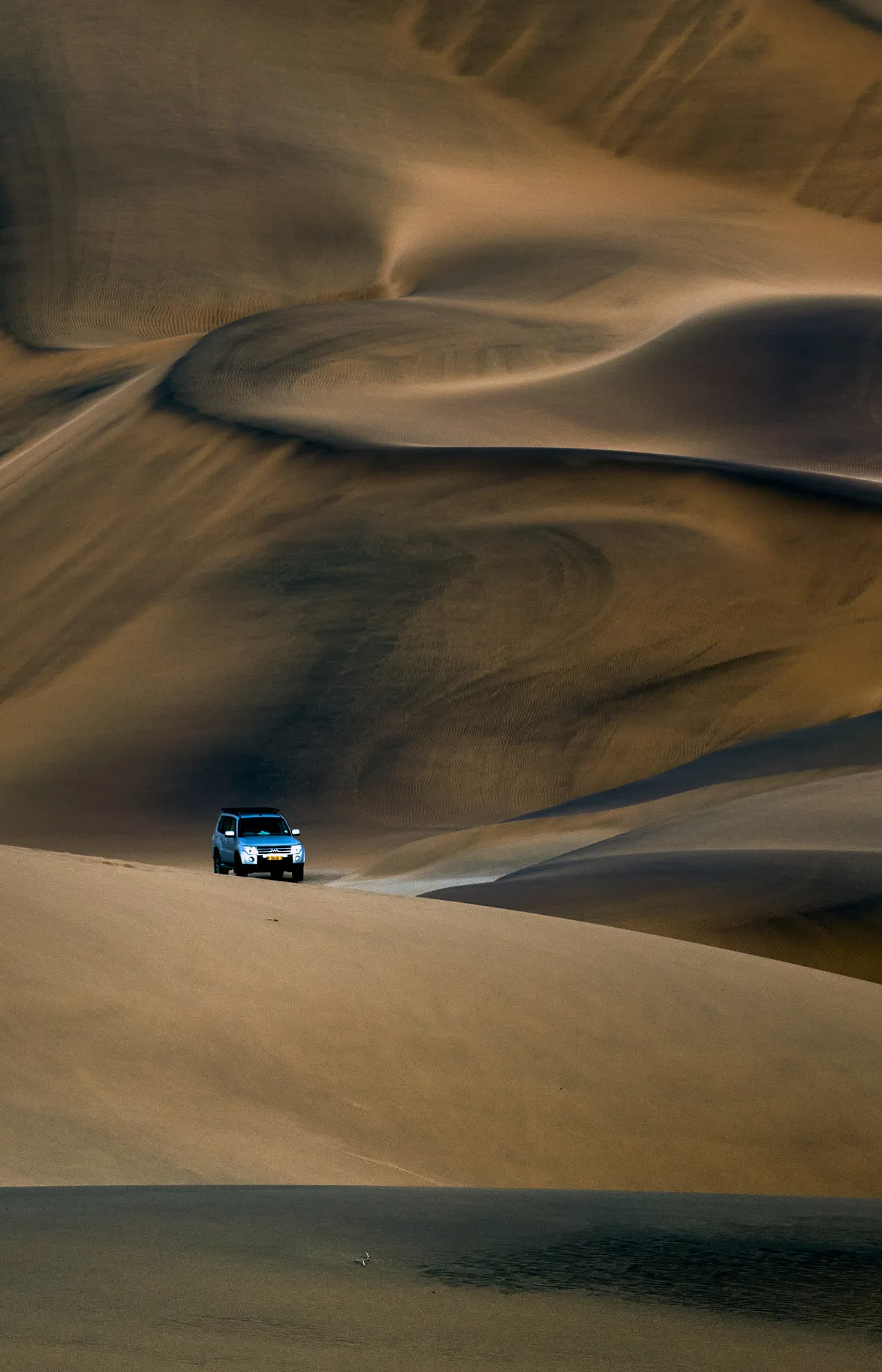
Choosing Your Rental
Out here, “cheap” is a dangerous strategy. Things will eventually go wrong, and when they do, what matters is the support system. I suggest looking to Howard Sivitson and the team at Namibia Car Rental. Their reputation is built not only on their exceptionally well-maintained modern fleet, but also on their willingness to assist and cater to their clients' needs.
The Physics of the Gravel Road
The Braking Trap: The mistake that causes most vehicles
to roll is
braking while turning. Drivers enter a bend too fast and instinctively slam on the brakes while the
wheels are turned. The tyres lose grip, slide and bite into the loose substrate, and the car flips. If
you enter a turn too quickly, straighten the wheels before applying the brakes, then release them to
regain traction before commencing the turn.
The 4x4 Advantage: I always engage 4x4 High Range the moment I leave the tar. It
provides far superior
stability and traction on the uneven surface of a gravel road, giving you an extra edge you may just
need if the unforeseen happens.
Tyre Pressure: Tyre pressure is one of the most controversial topics within any 4x4
community.
The basic concept is that the lower the tyre pressure, the larger your contact area with either sand or
gravel. A heavy vehicle with hard tyres not only destroys the vehicle and tyres themselves, but also the
road. Corrections are created through unnecessary acceleration and over-inflated tyres. You will notice
that corrections are always more severe on an incline.
The Golden Rule: Drive slower than you think you need to. If you are running late, do
not take
chances. You likely have a rooftop tent—pull over, sleep, and arrive alive.
Dust Management:
The Pressure Secret
Perhaps the most misunderstood feature on a modern 4x4 is the canopy vents. Most travellers leave them closed. In reality, it is the opposite. When you drive, a vacuum is created behind the vehicle, which sucks silt through the seals. By opening those front-facing vents, you pressurise the canopy. The incoming air creates a positive-pressure zone, forcing air out of any gaps and forming an invisible barrier that keeps your gear pristine.
The Ethics of the Track
This is not a suggestion, it's a plea for consideration: Never leave the established track. The top layer of our gravel plains is a delicate crust; once disturbed, it never truly heals and will erode further over time as the wind excavates the disturbance. I have walked areas where researchers drove in the 1960s, and sixty years later, the wind has eroded those tracks into permanent scars. Treat this world with the respect it deserves. Your tracks will outlive you.